How to Choose an Aluminum Tin for Tea and Spice: Size, Seal, and Moisture Control
Aluminum tins for tea and spice are not chosen by picking a good-looking tin first. They are chosen by fixing the fill form first, and then checking size, lid fit, and sample confirmation in that order: the factory standard aluminum box range runs from 10g to 200g in 10 sizes, the standard minimum order is 5,000 pieces per SKU, samples usually take 3-7 days, mass production usually takes 15-20 days after sample approval, and custom tooling development usually adds 7-15 days.
Aluminum tins for tea and spice are not chosen by picking a good-looking tin first. They are chosen by fixing the fill form first, and then checking size, lid fit, and sample confirmation in that order: the factory standard aluminum box range runs from 10g to 200g in 10 sizes, the standard minimum order is 5,000 pieces per SKU, samples usually take 3-7 days, mass production usually takes 15-20 days after sample approval, and custom tooling development usually adds 7-15 days.
The Three-Step Tea-Spice Tin Check: your quick reference
This guide uses one named method throughout, the Three-Step Tea-Spice Tin Check. It appears here, in each failure-mode section below, and again in the checklist and the FAQ, so a buyer can use the same three steps from first inquiry to sample approval.
| Step | What to check | How to fill it in | What goes wrong if it is skipped |
|---|---|---|---|
| 1. Fix the form | Loose-leaf tea, broken tea, whole spice, ground spice, or a mixed fill | Write the form and the particle size, not only the weight | The same weight in different forms takes up different space, so the tin ends up too large or too full |
| 2. Fix size and lid fit | Diameter, height, lid type, and the sealing performance shown by a sample | Shortlist 2-3 sizes from the factory table, then confirm with a real sample | Diameter alone ignores height and handling; lid type alone ignores how the lid actually closes |
| 3. Fix sample and bulk conditions | Sample confirmation items, finish, printing, minimum order, and lead time | Confirm the sample first, then fix the bulk conditions | Without sample confirmation, a problem in size, lid fit, finish, or printing is only found after mass production |
Factory standard aluminum box sizes (product and size only, in mm)
| Product | Size |
|---|---|
| 10g aluminum box | 35 x 18 |
| 15g aluminum box | 38.5 x 19.5 |
| 20g aluminum box | 47 x 20 |
| 30g aluminum box | 52 x 20 |
| 50g aluminum box | 57 x 26.5 |
| 60g aluminum box | 68 x 26 |
| 80g aluminum box | 68 x 35 |
| 100g aluminum box | 83 x 27 |
| 150g aluminum box | 83 x 38 |
| 200g aluminum box | 92 x 44.5 |
The table above uses the factory complete-set sizes. Packing quantities and carton details are deliberately not listed here. Weight in the product name is only part of the product name. It does not mean that every tea or spice at the same weight takes up the same space. The final choice must be confirmed with a sample filled with the real product.
For lid sizes, see the published aluminum lid guide, which lists 21 standard lid sizes: https://www.aluminumtin.com/news/aluminum-lid-size-guide - Do not pair a lid to a box by diameter alone. Lid-to-box pairing must be confirmed with a sample.
Failure 1: Choosing by weight alone, and ignoring the fill form
This is the most common sizing failure in tea and spice packaging, and it happens before any other decision is made. A buyer reports a single weight, a supplier picks a tin for that weight, and the tin arrives either half-empty or overfilled. The problem is not the weight. The problem is that weight was treated as if it were volume.
Loose-leaf tea is bulky. Broken tea packs more tightly. Whole spices sit differently from ground spices, and a fine powder settles differently again. Two fills at the same weight can therefore need different internal space, different heights, and different handling. A tin that looks right on a size table can still be wrong for the actual fill.
The Three-Step Tea-Spice Tin Check prevents this by putting form before size. Step 1 asks the buyer to write down the form first: loose leaf, broken leaf, whole spice, ground spice, or a blend, together with a plain description of particle size. Only then does Step 2 move to the size table. Shortlist two or three candidate sizes, fill a sample with the real product, and check three things at once: does it fill well without forcing, does it leave a sensible headspace, and can it be taken out without spilling.
A useful sample test is simple and does not need special equipment. Fill the sample tin as it would be filled in normal use, close it, open it, and take the product out in the way a customer would. Repeat that cycle a few times. If the fill looks uneven, if the product bridges across the opening, or if the last portion is hard to reach, the size is wrong even if the diameter looked right on paper. Change the candidate, not the fill, and test again.
If you have not yet fixed the fill form, write the form and the particle description into your inquiry first. That one line prevents most of the back-and-forth that follows a weight-only inquiry. You can send it through the contact page: https://www.aluminumtin.com/contact
Failure 2: Judging the seal by lid type alone, without a sample sealing test
Tea loses aroma when it is exposed to air and moisture. Spice loses aroma too, and strong spices can pass aroma to anything stored nearby. A lid that merely closes is therefore not enough. The lid must close consistently, stay closed in normal handling, and keep the same performance after repeated opening and closing.
The failure here is to treat lid type as a guarantee. A screw-top lid is a good starting point for tea and spice, because a threaded closure is designed to be opened and closed repeatedly. But lid type alone does not prove sealing performance for a specific tin, a specific fill, or a specific batch. Edge fit, thread engagement, and the way the lid sits after filling all matter, and none of them can be judged from a product photo.
Use Step 2 of the Three-Step Tea-Spice Tin Check for this. Fill a sample, close it as a customer would, and leave it in normal storage for several days. Then open it and check aroma, appearance, and moisture feel, and check whether the lid has loosened or sits unevenly. Test strong spices separately from mild teas, because a spice that is fine on its own can still affect a neighbouring product if storage is shared. If a sample shows a loose lid or an uneven edge, do not accept it on the basis that the lid type is correct. Ask for a corrected sample and test again.
Lid size reference is available in the published lid guide, with 21 standard sizes. That guide is a reference for lid dimensions only. It does not claim that a lid of a similar diameter fits a particular box. Always confirm lid fit with a sample of the actual box and lid together.
If moisture and aroma transfer are your main worry, write "sample sealing test required" into your inquiry, together with the fill form and the storage conditions you plan to use. That makes the test part of the sample confirmation, rather than something discovered after bulk production.
Failure 3: Looking at diameter only, and ignoring height and handling
Diameter is the easiest number to compare, so it gets most of the attention. Height and handling get far less, and that is where everyday usability is decided. A tin with the right diameter but the wrong height can be hard to fill, hard to use, or hard to store, even though it looked correct in a table.
A shallow tin suits a small, frequently used fill, because the product is easy to reach and easy to see. A taller tin suits a larger fill, but it can make the last portion harder to reach if the opening is narrow relative to the depth. The right balance depends on how the product will be taken out: poured, spooned, or picked by hand. Each method favours a different combination of diameter and height, and none of them can be settled by diameter alone.
Step 2 of the Three-Step Tea-Spice Tin Check therefore checks diameter and height together. When you shortlist from the factory table, write down both numbers for each candidate, not only the diameter. Then test handling with a sample: fill it, close it, open it, and take the product out in the intended way. Check whether the product spills at the edge, whether a spoon fits, and whether the tin feels stable when it is set down open. If handling feels awkward in the sample, it will feel awkward at scale, no matter how tidy the size table looked.
If you are unsure about height, include the intended taking-out method in your inquiry. A sample tested with the real handling method will settle diameter and height together, in one round, instead of requiring a second sample round later.
Failure 4: Judging finish and printing by colour alone, and ignoring batch consistency
A sample that looks good in a photo does not guarantee that a full batch will look the same. Colour, finish, and printing all need a physical reference, because screens, lighting, and photography change how a colour appears. This failure is common with tea and spice packaging, where shelf appearance matters and where a brand colour is part of the product identity.
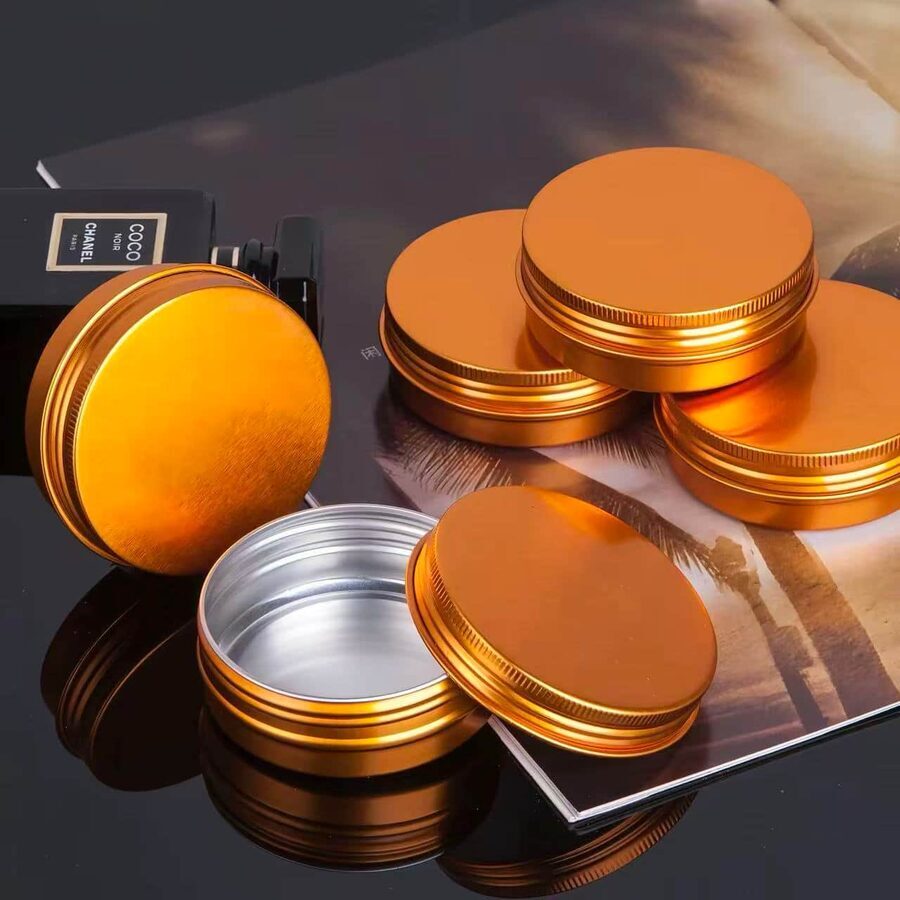
Only the finishes and printing methods listed in the site FAQ should be used as the confirmed starting point. Verified finishes are silver, matte, brushed, polished, and custom color. Verified printing methods are silk screen, laser engraving, offset, and embossing-debossing. See the FAQ for the full list: https://www.aluminumtin.com/faq
When you confirm finish and printing, write them down by name, not by a vague colour description. Use the approved sample as the batch reference, and check the lid face and the body together, because printing can behave differently on a flat lid face and on a curved body. If a batch sample drifts from the approved sample in finish or printing, that drift should be caught at sample comparison, not after the batch is complete.
If you have a clear finish or printing requirement, write the finish name and the printing method name into your inquiry, and ask for the sample to be used as the batch reference. That single sentence makes batch consistency a confirmation item, rather than a matter of opinion after production.
Failure 5: Skipping sample confirmation and going straight to bulk production
Skipping the sample stage is usually presented as a way to save time. In practice it moves every problem later, where it is harder and slower to fix. A size error, a lid-fit error, a finish error, or a printing error that would have been visible in a sample becomes a bulk error instead.
The confirmed rhythm in the FAQ is straightforward and should be planned around, not skipped. Samples usually take 3-7 days. Mass production usually takes 15-20 days after sample approval. Custom tooling development usually adds 7-15 days. Those are time figures, not commercial figures, and they are the figures to use when planning a launch date.
Step 3 of the Three-Step Tea-Spice Tin Check turns sample confirmation into a checklist, not a general approval. At minimum, confirm size, lid fit, finish, printing, fill behaviour, and handling behaviour, all on the same sample, filled with the real product. Approve in writing only when each item has been checked. If any item fails, correct that item and re-test that item, rather than approving the sample with a known flaw and hoping the bulk run will correct it.
If your timeline is tight, confirm the sample time and the mass-production time in your inquiry first, and then build your launch plan around those confirmed times. A sample round that takes a few days is far shorter than a bulk correction that takes weeks.
Failure 6: Planning minimum order and lead time as if this were retail ordering
Tea and spice buyers who are used to retail ordering often plan in hundreds of units. Factory ordering for custom aluminum tins works differently, and planning with retail numbers leads to a plan that cannot be executed as written.
The standard minimum order is 5,000 pieces per SKU. A small trial order may be negotiable depending on the product, as stated in the FAQ, but it should not be assumed. The correct way to plan is to list each SKU separately, with its own quantity, and check each SKU against the minimum order, rather than adding several SKUs together and treating the total as if it were one order. See the FAQ: https://www.aluminumtin.com/faq
Lead time follows the same logic. Mass production time is counted after sample approval, not from the first inquiry, and custom tooling development time is additional. A plan that counts lead time from the inquiry date, or that forgets the tooling development period, will arrive late even if production itself runs on time.
If you are planning a multi-SKU launch, write each SKU and its quantity separately in your inquiry. That makes the minimum-order check straightforward for every SKU, and it prevents a plan that looks complete in total but fails on a single SKU.
How the numbers in this article were worked out
Sizes in this article come from the factory specification table, using the complete-set values. Finishes, printing methods, minimum order, sample time, mass-production time, and tooling development time come from the site FAQ. No size in this article is copied from a competitor table, and no size outside the factory table is presented as a site standard size.
Weight is not converted to volume in this article. Tea and spice forms differ in bulk and particle size, so the same weight can take up different space. For that reason this article does not claim a fixed mapping such as a particular weight of tea must use a particular tin size. Any such mapping must be established by filling a sample with the real product and checking fill, handling, and lid fit.
No commercial amounts or amount formulas appear in this article. Details that can only be settled through communication with the buyer are left for inquiry, and are not stated here as if they were fixed. The time figures above are the only commercial conditions stated, because they are the figures given in the FAQ.
Nothing in this article is a substitute for a sample. Sample confirmation remains the step that settles size, lid fit, finish, printing, fill behaviour, and handling behaviour for a specific product.
2026 tea and spice tin selection: what still applies this year
The selection logic for 2026 has not changed in its essentials. Fix the fill form first, check size and lid fit with a sample, and confirm the sample before fixing bulk conditions. That order still prevents the same six failures described above.
What has changed is execution. Buyers in 2026 are more likely to ask for a sample sealing test and a handling test before bulk production, rather than relying on a size table alone. That is a welcome change, because it moves the two most product-specific checks, sealing and handling, into the sample stage where they belong.
The Three-Step Tea-Spice Tin Check therefore still applies in 2026, without modification. Fix the form, fix size and lid fit by sample, and fix sample and bulk conditions in that order. A buyer who follows those three steps in order will have a sample that answers the sizing question, the sealing question, and the handling question before bulk production begins.
Frequently asked questions
Can tea and spice share the same size table? Yes, they can share the same factory size table as a reference, but they cannot be swapped by weight alone. Form matters. A loose-leaf tea and a ground spice at the same weight take up different space, so the final size must be confirmed with a sample of the real product.
Is a larger tin always better? No. This is the counter-intuitive point in this guide. A tin that is too large for its fill leaves excess headspace, makes handling awkward, and can make aroma and moisture control harder to judge. The right tin is one that fills well, handles well, and closes well, not simply the largest tin that fits the budget of space on a shelf.
Is a screw-top lid always more sealing than other lid types? Not necessarily. Lid type is a starting point, not a guarantee. Sealing performance must be shown by a sample of the actual box and lid, filled with the real product and stored in normal conditions. A lid that loosens, sits unevenly, or fails after repeated opening has failed the test, whatever its type.
How should aluminum lid sizes be referenced? Use the published aluminum lid guide, which lists 21 standard lid sizes, as a dimension reference only. Do not pair a lid to a box by diameter similarity alone. Pairing must be confirmed with a sample of the actual box and lid together.
What are the standard minimum order and lead time? The standard minimum order is 5,000 pieces per SKU. Samples usually take 3-7 days, mass production usually takes 15-20 days after sample approval, and custom tooling development usually adds 7-15 days. A small trial order may be negotiable depending on the product, as stated in the FAQ.
What is the minimum information to send with an inquiry? Fill form, candidate sizes, lid-fit requirement, finish and printing method by name, and the quantity for each SKU separately. The more specific that information is, the faster sample confirmation can be completed.
Can I use the Three-Step Tea-Spice Tin Check for coffee as well? The same three steps apply to coffee as a dry fill: fix the form first, check size and lid fit with a sample, and confirm the sample before bulk conditions. Coffee was not the main subject of this guide, so a coffee-specific guide would still need its own sample confirmation for its own fill form.
Checklist: use the Three-Step Tea-Spice Tin Check before you reply to a supplier
- Step 1, form: loose leaf, broken leaf, whole spice, ground spice, or blend, with particle description written down.
- Step 2, size and lid fit: 2-3 candidate sizes from the factory table, diameter and height both noted, sample filled with the real product.
- Step 2, sealing: sample stored for several days, lid checked for loosening and uneven fit, aroma and moisture feel checked on opening.
- Step 2, handling: product taken out in the intended way, spoon fit and spill checked, stability when open checked.
- Step 3, finish and printing: finish and printing method named from the FAQ list, approved sample used as the batch reference.
- Step 3, bulk conditions: each SKU quantity checked against the 5,000-piece standard minimum, sample time and mass-production time confirmed, tooling development time counted separately where applicable.
- Final step: approve the sample in writing only when every item above has been checked.
Internal links: FAQ https://www.aluminumtin.com/faq, Contact https://www.aluminumtin.com/contact, Products https://www.aluminumtin.com/products, Aluminum box size guide https://www.aluminumtin.com/news/aluminum-box-size-guide-10g-200g, Aluminum lid size guide https://www.aluminumtin.com/news/aluminum-lid-size-guide
Frequently asked questions
Can tea and spice share the same size table?
Yes, they can share the same factory size table as a reference, but they cannot be swapped by weight alone. Form matters, so the final size must be confirmed with a sample of the real product.
Is a larger tin always better?
No. A tin that is too large for its fill leaves excess headspace, makes handling awkward, and can make aroma and moisture control harder to judge.
Is a screw-top lid always more sealing than other lid types?
Not necessarily. Sealing performance must be shown by a sample of the actual box and lid, filled with the real product and stored in normal conditions.
How should aluminum lid sizes be referenced?
Use the published aluminum lid guide, which lists 21 standard lid sizes, as a dimension reference only. Pairing must be confirmed with a sample of the actual box and lid together.
What are the standard minimum order and lead time?
The standard minimum order is 5,000 pieces per SKU. Samples usually take 3-7 days, mass production usually takes 15-20 days after sample approval, and custom tooling development usually adds 7-15 days.