How to Choose an Aluminum Tin for DIY Candle Making: Maker Workflow, Size, and Seal
Choose a DIY candle tin by maker workflow first: small-batch trial, repeated testing, and sample approval, then mass production. The factory range is 10g–200g in 10 models, standard MOQ 5,000 pcs per SKU, samples usually 3–7 days, and mass production 15–20 days after sample approval.
Choose a DIY candle tin by maker workflow first: small-batch trial, repeated testing, and sample approval, then mass production. The factory range is 10g–200g in 10 models, standard MOQ 5,000 pcs per SKU, samples usually 3–7 days, and mass production 15–20 days after sample approval.
The Three-Step DIY Candle Trial Check
Use it in the quick table, the checklist, and the Q&A: step one, check the trial shortlist; step two, check trial testing; step three, check mass-production timing.
Quick Table: Trial Shortlist, Trial Testing, Mass-Production Timing
| Check step | Confirm first | Test with a sample |
|---|---|---|
| Trial shortlist | Complete-set size table, trial use, and handling | Diameter and height both reviewed; sizes used only as a shortlist, with no hard wax-to-size mapping |
| Trial testing | Real trial sample, lid fit, and repeated opening and closing | Fill with the real trial sample, open and close repeatedly, and confirm lid fit and handling |
| Mass-production timing | Sample and mass-production timing structure | Whether sample 3–7 days and mass production 15–20 days are confirmed in communication |
This table does not map any wax amount to a specific size. Always confirm by trial sample testing. No pouring, wick, or other unverified process parameters are included. No cost content is included.
How This Differs from the Candle Guide
The existing candle guide covers wax volume, size, and lid fit as a selection angle. This guide covers the maker workflow angle: small-batch trial, repeated testing, sample approval, and only then mass production. It is not a retitled repeat of the candle guide. Its focus is how to use the tin in a trial workflow, how to test it, and how to confirm it, not wax-volume selection alone.
6 Failure Modes
1. Choosing by wax amount alone, ignoring the trial workflow
Judging by wax amount, without considering the trial workflow, can leave a tin that does not trial or handle well. First shortlist by trial workflow, then confirm with a trial sample. Do not judge by wax amount alone.
2. Skipping small-batch trial and deciding by mass-production thinking
Applying mass-production thinking directly to a DIY trial can skip the repeated-testing step. First trial in small batches, test repeatedly, and approve the sample, then discuss mass production. Do not skip the trial.
3. Checking lid type only, without testing repeated opening and closing
Checking a lid type name without repeated opening and closing can miss lid fit and handling problems that appear only after repeated use. Test a trial sample with the real sample, opening and closing repeatedly, before confirming lid fit.
4. Checking diameter only, ignoring height and handling
Checking diameter without height can leave a tin too shallow or too deep to use easily. Review both complete-set diameter and height, then shortlist by trial sample testing.
5. Judging surface and print by colour name only, without testing real sample contact
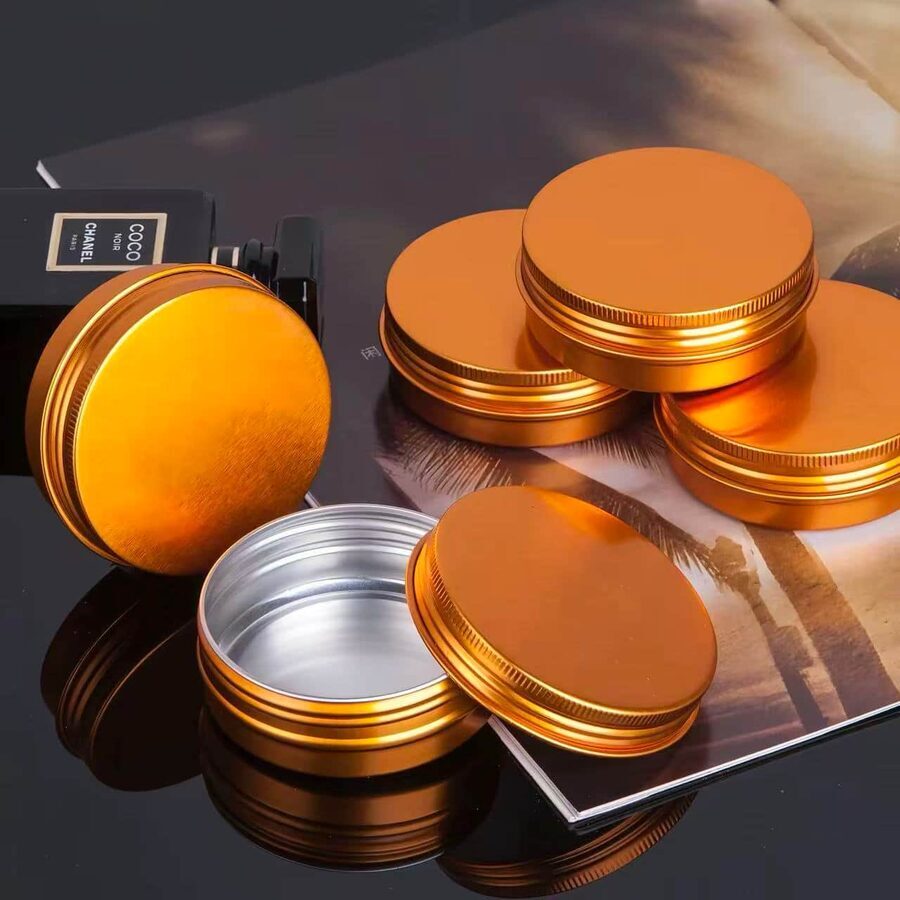
The same colour name can behave differently after real sample contact. Surface and print options use only the FAQ-verified list: surfaces silver, matte, brushed, polished, and custom colour; print by silk screen, laser engraving, offset, and embossing-debossing. Durability is confirmed by real trial samples.
6. Estimating quantity and timing by retail thinking
The standard MOQ is 5,000 pcs per model, samples usually take 3–7 days, and mass production is 15–20 days after sample approval (time only, no cost content). Whether a smaller trial order is possible depends on the product and is confirmed in communication. Do not estimate from retail quantities.
Size Table (Product + Size Only)
Factory aluminum box complete-set sizes: 10g 35×18; 15g 38.5×19.5; 20g 47×20; 30g 52×20; 50g 57×26.5; 60g 68×26; 80g 68×35; 100g 83×27; 150g 83×38; 200g 92×44.5 (mm).
Do not pair a lid to a box by similar diameter. Aluminum lids are covered separately in the lid size guide, with 21 sizes.
2026 Timeliness
This guide is written from the factory size table and FAQ as of October 2026. If sizes, MOQ, or lead times change, the version confirmed in communication applies.
Method Disclosure
This guide contains no cost content, no trade-term wording, no unverified certificates, grades, wall thickness, standards numbers, legal full name, founded year, employee count, or credit code, and no packing quantities. It includes no pouring temperature, wick specification, burn time, or other unverified process parameters, and no hard wax-to-size mapping. Trial work is described only as a workflow method. No unverified burn, heat-resistance, or safety performance is claimed; related parameters are left blank and confirmed in communication.
Pre-Batch Checklist (Three-Step DIY Candle Trial Check)
- Trial shortlist done: complete-set size table reviewed, both diameter and height confirmed.
- Trial sample tested: real trial sample tested for lid fit, repeated opening and closing, and handling.
- Surface and print confirmed: FAQ-verified list only, durability confirmed by trial sample.
- Timing and quantity confirmed: sample and mass-production timing and standard MOQ confirmed in communication.
Q&A
- What should I check first for a DIY candle tin? First shortlist by trial workflow, then test opening and closing with a trial sample, then check the timing structure.
- How does this differ from the existing candle guide? The existing candle guide covers wax volume, size, and lid fit as a selection angle. This guide covers the maker trial workflow: small-batch trial, repeated testing, sample approval, and then mass production.
- What should trial sample approval test? Fill with the real trial sample and open and close repeatedly, confirming lid fit and handling.
- Can a size name be used directly to choose a tin? No. Check complete-set diameter and height, then confirm with a trial sample.
- How is lid-to-box pairing confirmed? Not by similar diameter. Pairing is confirmed by sample testing and in communication.
- How are surface and print chosen? Use only the FAQ-verified list. Durability is confirmed by real trial samples.
- What are the MOQ and lead times? The standard MOQ is 5,000 pcs per model, samples usually take 3–7 days, and mass production is 15–20 days after sample approval.
Sources
- FAQ: https://www.aluminumtin.com/faq
- Products: https://www.aluminumtin.com/products
- Aluminum box size guide: https://www.aluminumtin.com/news/aluminum-box-size-guide-10g-200g
- Aluminum lid size guide: https://www.aluminumtin.com/news/aluminum-lid-size-guide
- Candle guide (related reading, not a substitute, wax-volume selection angle): https://www.aluminumtin.com/news/how-to-choose-aluminum-tin-for-candles
Frequently asked questions
What should I check first for a DIY candle tin?
First shortlist by trial workflow, then test opening and closing with a trial sample, then check the timing structure.
How does this differ from the existing candle guide?
The existing candle guide covers wax volume, size, and lid fit as a selection angle. This guide covers the maker trial workflow: small-batch trial, repeated testing, sample approval, and then mass production.
What should trial sample approval test?
Fill with the real trial sample and open and close repeatedly, confirming lid fit and handling.
Can a size name be used directly to choose a tin?
No. Check complete-set diameter and height, then confirm with a trial sample.
How is lid-to-box pairing confirmed?
Not by similar diameter. Pairing is confirmed by sample testing and in communication.
How are surface and print chosen?
Use only the FAQ-verified list. Durability is confirmed by real trial samples.
What are the MOQ and lead times?
The standard MOQ is 5,000 pcs per model, samples usually take 3–7 days, and mass production is 15–20 days after sample approval.